2023年1月5日星期四

High-Speed Steel vs Tungsten Steel Hochgeschwindigkeitsstahl vs. Wolframstahl Stal szybkotnąca kontra stal wolframowa

 High-Speed Steel vs Tungsten Steel

High-Speed Steel vs Tungsten Steel
High-speed steel vs tungsten steel, what's the difference? If you want to find the answer to this question, then you've come to the right place. In this article, we will take a closer look at the differences between high-speed steel and tungsten steel.
High-Speed Steel vs Tungsten Steel
What is high-speed steel?
High-Speed Steel (HSS) is a tool steel with high hardness, wear-resistance, and heat resistance. HSS is a kind of complex alloy steels, which contains carbide-forming elements such as tungsten, molybdenum, chromium, vanadium, and cobalt, and the total amount of alloy elements is about 10-25%.
HSS is mainly used to manufacture complex thin blade and impact-resistant metal cutting tools, as well as high-temperature bearing and cold extrusion die, such as a turning tool, drill bit, hob, machine saw blade and high demand die, etc. It can still maintain a high hardness in the high speed cutting under the condition of high temperature (500 ℃), which is the most main characteristic of high-speed steel, the red hardness.
After quenching and low temperature tempered, carbon tool steel has a high hardness at room temperature, but the hardness was a sharp drop in when the temperature higher than 200 ℃. When the temperature reaches 500 ℃, the degree of hardness was similar to annealing state, completely lost the ability to cut metal, which limits the application of carbon tool steel as a cutting tool. The high-speed steel makes up for the fatal defects of carbon tool steel due to its red hardness.
What is tungsten steel?
Tungsten steel (hard alloy) has a series of excellent properties such as high hardness, wear resistance, strength and toughness, heat resistance, and corrosion resistance. Especially, its high hardness and wear resistance also remain stable even under the temperature of 500 ℃, and there is still high hardness at 1000 ℃.
The main components of tungsten steel are tungsten carbide and cobalt, which account for 99% of all the components and 1% are other metals. Tungsten steel, also known as the hard alloy, is regarded as the teeth of modern industry. Tungsten steel is widely used as the material, such as turning tool, milling cutter, drill bit, boring cutter, etc. The cutting speed of the new cemented carbide is hundreds of times that of carbon steel.
Tungsten steel is a sintered composite material containing at least one kind of metal carbide, and tungsten carbide, cobalt carbide, niobium carbide, titanium carbide, and tantalum carbide are common components of tungsten steel. The grain size of the carbide component is usually between 0.2-10 microns, and the carbide grains are bonded together with metal binders. Bonding metals are generally iron group metals, commonly used are cobalt, nickel, so there are tungsten-cobalt alloy, tungsten-nickel alloy, and tungsten-titanium cobalt alloy.
The sintering process of tungsten steel is to press the powder into the blank, then heat it into the sintering furnace to a certain temperature (sintering temperature), keep it for a certain time (holding time), and then cool it down, so as to obtain the tungsten steel material with required properties.
Shenzhen Oyea Machinery Co., Ltd. production Aristo Axyz Atom Benz Blackman & White Bullmer Comagrav CombiPro Data Technology DRD Dierre Dyss Ecocam Elcede Elitron Esko Kongsberg Gerber Graphtec Gunnar Haase iEcho Science & Technology JWei Kasemake Krause Kuris RuiZhou Ronchini Lasercomb Protek Marbach Mécanuméric Mimaki Misomex Multicam RolandSei Summa Valiani Wild Zünd...Tungsten Steel Blades

How Is Tungsten Carbide Currently Being Used?

 All throughout the world, there are numerous applications where metal compounds are being used. But compared to any one of them,

tungsten carbide possesses the most unique attributes. Frequently used in jobs such as building applications, precise grinding and milling, jewelry production, and more, the addition of these materials can help create a pitting, scratch, rust, and heat resistant alloy.
The Milling Industry
For the manufacture of some mill inserts, finish mills, and other mill merchandise, tungsten carbide is used. In the milling and grinding industry, For applications that yield everything from the finest powder to coarsely grated material, tungsten carbide is preferred because it can be simply molded while remaining extraordinarily tough.
Tungsten Carbide’s Newest Application
Every day, tungsten carbide gains popularity for its newly built jewelry production reputation. In the crafting of jewelry such as earrings, pendants, and rings, it is a desirable alloy thanks to its extreme hardness. Additionally, it is stunningly gorgeous when polished appropriately!
All the rage, as of late, are engagement and wedding rings made from tungsten carbide. Because, compared to gold, it is less expensive, it is exceptionally popular with frugally minded individuals or those on a tight budget.
The Mining Industry
Possibly more than any other industry, numerous building applications use drilling tools created from tungsten carbide. Cutting tools, drill bits, and other mining equipment utilizes approximately 65% of today’s tungsten carbide supply. Due to its resistance to wear and tear, as well as its hardness, in mining applications, it is the preferred material – even over stainless steel.
The hardness of tungsten carbine is only exceeded by diamond. In some applications, the hardness offered coupled with its conductivity make tungsten carbide even more alluring. What’s more, it can be melded with other metals, sharpened to precision, and molded into seemingly limitless shapes.
Tungsten Carbide Combinations
Composite supplies and specialized alloys are created when tungsten carbide is combined with other metals. To make components that can be utilized in applications such as the aeronautical market, radiation shielding supplies, industrial gear generating, electronics, and more industrial building situations, it may be joined with copper, silver, iron, and nickel.
Further Tungsten Carbide Benefits
Periodically, regardless of the benefits of tungsten carbide, components made from it will eventually need replacing. The good news here is that carbide is extremely recyclable. There are, in fact, recycling facilities that do just that. These days, if something is recyclable, it is preferable, with many industries concentrating highly on “going green”.
The mechanical and thermal attributes of tungsten carbide, combined with its durability, high wear resistance, and other attributes make it one of the most desirable materials in the industrial marketplace.

Shenzhen Oyea Machinery Co., Ltd. 
production Aristo Axyz Atom Benz Blackman & White Bullmer Comagrav CombiPro Data Technology DRD Dierre Dyss Ecocam Elcede Elitron Esko Kongsberg Gerber Graphtec Gunnar Haase iEcho Science & Technology JWei Kasemake Krause Kuris RuiZhou Ronchini Lasercomb Protek Marbach Mécanuméric Mimaki Misomex Multicam RolandSei Summa Valiani Wild Zünd...Tungsten Steel Blades

Tools for Zund digital cutting systems

 Tools


Universal Drawing Tool (UDT) - For drawing lines with a pen. Useful for labeling parts.

Universal Cutting Tool (UCT) - For most cutting operations. Uses a variety of inserts. Does not oscillate, drags blade through material.

V-Cut Tool (VCT) - For cutting angles in soft material. As this tool drags the knife through the material, it is not suitable for very thin material as it lifts the material as it cuts, nor for very thick material, as the material begins to crush rather than cut. 1/8" - 3/18" foam core is a reasonable material range for this tool.
Electric Oscillating Tool (EOT) - For soft materials such as cardboard or foamcore. Good when UCT excessively drags or deforms the material.

Pneumatic Oscillating Tool (POT) - like EOT but with greater blade throw. Good with thicker materials that the EOT has trouble cutting cleanly. The POT cuts a little cleaner than the EOT, but because it is pneumatic and runs off the same compressor as the Onsrud and woodshop air hookups, it cannot be used while the others are running. Only use the POT if the Onsrud is not currently operating.

Driven Rotary Tool (DRT) - Uses a rotating circular blade. For fabrics and fabric like materials. Minimizes force acting on the material, but has the greatest overcut due to the blade geometry.

Router Module (RMA) - For routing or engraving materials that cannot be cut with a knife. Uses router bits whose diameter also limits depth of cut, potentially. Small parts may require bridges to maintain connection to surrounding material while being cut.
CTT
PTT
Shenzhen Oyea Machinery Co., Ltd. production Aristo Axyz Atom Benz Blackman & White Bullmer Comagrav CombiPro Data Technology DRD Dierre Dyss Ecocam Elcede Elitron Esko Kongsberg Gerber Graphtec Gunnar Haase iEcho Science & Technology JWei Kasemake Krause Kuris RuiZhou Ronchini Lasercomb Protek Marbach Mécanuméric Mimaki Misomex Multicam RolandSei Summa Valiani Wild Zünd...Tungsten Steel Blades

Tools for Zund digital cutting systems

 Tools for Zund digital cutting systems

Tools

Universal Drawing Tool (UDT) - For drawing lines with a pen. Useful for labeling parts.

Universal Cutting Tool (UCT) - For most cutting operations. Uses a variety of inserts. Does not oscillate, drags blade through material.

V-Cut Tool (VCT) - For cutting angles in soft material. As this tool drags the knife through the material, it is not suitable for very thin material as it lifts the material as it cuts, nor for very thick material, as the material begins to crush rather than cut. 1/8" - 3/18" foam core is a reasonable material range for this tool.
Electric Oscillating Tool (EOT) - For soft materials such as cardboard or foamcore. Good when UCT excessively drags or deforms the material.

Pneumatic Oscillating Tool (POT) - like EOT but with greater blade throw. Good with thicker materials that the EOT has trouble cutting cleanly. The POT cuts a little cleaner than the EOT, but because it is pneumatic and runs off the same compressor as the Onsrud and woodshop air hookups, it cannot be used while the others are running. Only use the POT if the Onsrud is not currently operating.

Driven Rotary Tool (DRT) - Uses a rotating circular blade. For fabrics and fabric like materials. Minimizes force acting on the material, but has the greatest overcut due to the blade geometry.

Router Module (RMA) - For routing or engraving materials that cannot be cut with a knife. Uses router bits whose diameter also limits depth of cut, potentially. Small parts may require bridges to maintain connection to surrounding material while being cut.
CTT
PTT
Shenzhen Oyea Machinery Co., Ltd. production Aristo Axyz Atom Benz Blackman & White Bullmer Comagrav CombiPro Data Technology DRD Dierre Dyss Ecocam Elcede Elitron Esko Kongsberg Gerber Graphtec Gunnar Haase iEcho Science & Technology JWei Kasemake Krause Kuris RuiZhou Ronchini Lasercomb Protek Marbach Mécanuméric Mimaki Misomex Multicam RolandSei Summa Valiani Wild Zünd...Tungsten Steel Blades

Tools & Blades for Zund digital cutting systems


Tools & Blades for Zund digital cutting systems 

Zund offers quite a few different tools, each of which is optimally suited for a particular material: creasing tools, electric and pneumatic oscillating tools, perforating tools, driven rotary tool, universal cutting tools, routers (300W tool and 1kW router module), drawing tools and several others. Below are some of the common cutting tools, brief descriptions of them, and what blades are used with them for cutting.

Zund Cutting Tool

Overview

Compatibility

Mountable blades

Universal Cutting Tool

The Universal cutting tool UCT is used together with flat-stock drag knives and oscillating pointed blades to cut through a wide range of materials less than 5mm thick such as paper, vinyl, hard foam, cardboard, PVC banners, tarpaulin, coated textiles, PC, PP, plastic, film and other soft and thin materials. This tool is the most popular and used among plotters.

Compatible with G3, S3, D3, L3

Blades to use with UCT: Z10Z11Z16Z17, Z44, Z46, Z101, Z103 Z83

Kiss Cut Tool 

The Kiss Cut Tool KCT is used in conjunction with a round-stock drag knife to hole or etch soft and thin materials up to 3mm thick such as self-adhesive vinyls, paper, plastic, masking film, fabric, fleece or harder substrates where light etching or film removal is required. A distinctive feature of the tool is that it is spring loaded.

Compatible with G3, S3, D3

Blades to use with KCT: Z1Z2, Z3, Z4, Z5, Z6, Z7

Electric Oscillating Tool

The Electric Oscillating Tool EOT is a tool used with flat and pointed oscillating blades for cutting through soft to medium density materials up to a thickness of 3 mm that require sawing, such as, cardboard, twin-wall sheets, honeycomb cardboard, leather, rubber, foam boards.

Compatible with G3, S3, D3, L3

Blades to use with EOT: Z17, Z21Z22, Z23, Z26, Z28, Z29, Z41, Z43, Z62, Z63, Z104, Z204, Z205

Driven Rotary Tool

The Driven Rotary Tool DRT is a rotary tool used with a drag rotary knife for cutting through soft materials such as fabrics and film, paper, thin felt, etc.

Compatible with G3, S3, D3, L3

Blades to use with DRT: Z50, Z51, Z52

Pneumatic Oscillating Tool

The Pneumatic Oscillating Tool POT is a tool used with a long oscillating drag blade for cutting through medium to high density materials with thicknesses over 12 mm, such as honeycomb boards, rubber, felt and polycarbonates.

Compatible with G3, S3, L3, D3

Blades to use with POT: Z16, Z17, Z21, Z22, Z23, Z26, Z28, Z29, Z41, Z43, Z61, Z62, Z63, Z104, Z204, Z205

Press Cutting Tool

Press Cutting Tool PCT is a tool used with a flat-stock drag knives for economical cutting of corrugated cardboard up to a thickness of 7 mm 

Compatible with G3, S3, D3

Blades to use with PCT: Z16, Z17, Z104

V-Cutting Tool 

The V-Cutting Tool VCT is a tool used with a drag knife to cut through materials up to 16 – 25 mm thickness at different angles ( 0°, 5°, 10°, 15 °, 22.5°, 30°, 45°, 60°). Soft and medium density materials such as corrugated cardboard, honeycomb, twin-wall sheets, foam core materials, acoustic panels, polyester fiber boards can be cut with  VCT

Compatible with G3, D3

Blades to use with VCT: Z70, Z71, Z701, Z73


Shenzhen Oyea Machinery Co., Ltd. 
production Aristo Axyz Atom Benz Blackman & White Bullmer Comagrav CombiPro Data Technology DRD Dierre Dyss Ecocam Elcede Elitron Esko Kongsberg Gerber Graphtec Gunnar Haase iEcho Science & Technology JWei Kasemake Krause Kuris RuiZhou Ronchini Lasercomb Protek Marbach Mécanuméric Mimaki Misomex Multicam RolandSei Summa Valiani Wild Zünd...Tungsten Steel Blades

ZUND Blades Types(drag blades, oscillating blades, rotary blades)

 ZUND Blades Types

In general, there are the following types of blades for Zund Cutters: drag blades, oscillating blades, rotary blades.
Drag blades
Drag knives are used in non-powered tools such as UCT, KCT, VCT, SCT, C2, insertion sleeve 40. Suitable for cutting foil, paper, thin folding cartons, banners, etc.
Round-stock blades (C2, C2P, KCT, KCM-S): Z1, Z2, Z3, Z4, Z5, Z7
Flat-stock blades (UCT, SCT, insert sleeve 40): Z6, Z10, Z11, Z44, Z46, Z101, Z102, Z103, Z83
V-cut blades: Z70, Z71, Z701, Z73
Mat-cutting blades (PPT): Z30, Z33, Z34, Z35
Oscillating blades
Oscillating blades used in EOT/POT oscillating tools for cutting thick and tough materials.
Oscillating blade – pointed: Z16, Z17, Z20, Z21, Z22, Z60, Z66, Z601, Z606, Z608
Oscillating blade – flat: Z26, Z41, Z42, Z61, Z62, Z63, Z64, Z68, Z69, Z82, Z201, Z202, Z203, Z204, Z603, Z605, Z607
Rotary blade
Rotary blades - decagonal blades - are used in DRT/PRT tools for cutting breathable materials such as textile, carbon fiber, glass fiber, etc.
Rotary blades: Z50, Z51, Z52, Z53
Shenzhen Oyea Machinery Co., Ltd. production Aristo Axyz Atom Benz Blackman & White Bullmer Comagrav CombiPro Data Technology DRD Dierre Dyss Ecocam Elcede Elitron Esko Kongsberg Gerber Graphtec Gunnar Haase iEcho Science & Technology JWei Kasemake Krause Kuris RuiZhou Ronchini Lasercomb Protek Marbach Mécanuméric Mimaki Misomex Multicam RolandSei Summa Valiani Wild Zünd...Tungsten Steel Blades

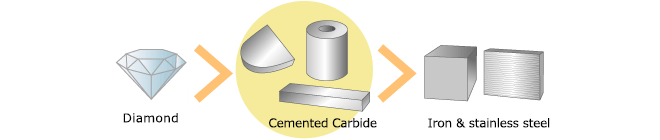
What is Cemented Carbide?


The hardness is next to diamond and same weight as gold.
What is Cemented Carbide? image

Cemented Carbide is an extremely hard metal.
It is harder than iron or stainless steel, and is second only to diamond.
It is twice as heavy as iron, and about the same weight as gold.
Not only is it hard, but it also has superior strength and elasticity, minimal strength loss in high temperatures, is highly wear resistant, and is used in metal tools and molds.

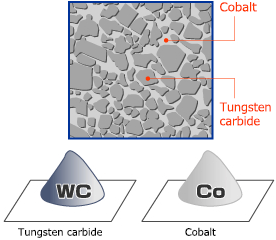
Tungsten carbide + cobalt
Tungsten carbide + cobalt image1
Tungsten carbide + cobalt image2

Cemented Carbide is just that: an alloy.
It is not a natural metal, but rather a man-made metal.
It is made up of tungsten carbide (WC) and cobalt (Co).
Tungsten carbide has a high melting point (2900℃), and will not melt like iron.
Because of this, we manufacture the alloy from powder by baking it at around 1300℃ to 1500℃ and allowing it to harden.
The material used to bind the powder is cobalt.

Used by many companies in a variety of ways
Characteristics of cemented carbide (typical example of WC-Co-based metal) 1)
Composition(mass%)Density
(Mg/m3
Hardness
HRA
Transverse rupture strength
(GPa)
Young’s modulus
(GPa)
Thermal conductivity
(W/m・K)
WCCo
10015.792-940.3-0.5720
97315.1-15.290-931.0-1.266888
95514.8-15.090-911.6-1.862080
901014.3-14.588-901.5-1.958471
851513.8-14.086-881.8-2.2548
802013.1-13.383-862.0-2.6500
752512.8-13.082-841.8-2.7467
703012.3-12.580-82
1008.917971
1)The Japan Cemented Carbide Tool Manufacturer’s Association: Handbook on cemented carbide tools, 1988
Shenzhen Oyea Machinery Co., Ltd. production Aristo Axyz Atom Benz Blackman & White Bullmer Comagrav CombiPro Data Technology DRD Dierre Dyss Ecocam Elcede Elitron Esko Kongsberg Gerber Graphtec Gunnar Haase iEcho Science & Technology JWei Kasemake Krause Kuris RuiZhou Ronchini Lasercomb Protek Marbach Mécanuméric Mimaki Misomex Multicam RolandSei Summa Valiani Wild Zünd...Tungsten Steel Blades